
You have just secured a massive order for canned sardines, and your margins are tight. You calculated the number of Electrolytic Tin Plate 1 sheets perfectly, but halfway through production, the coil runs out, and your line stops. You are short on material, and your profit just evaporated into the scrap bin.
To estimate scrap loss accurately, you must calculate the difference between your Theoretical Nesting Yield (geometric layout) and your Actual Manufacturing Yield. Typically, you should factor in 8-15% for geometric waste and add an additional 3-5% for process losses like edge trimming, lithography setup, and quality defects.
Understanding these numbers is the difference between a profitable contract and a financial disaster. Over my years in the industry, I have seen seasoned buyers treat scrap as a minor detail, only to face shortages during the canning season. Let’s break down the math so you never run short again.
Can you help me calculate the best sheet layout to minimize waste?
Nobody likes paying for metal that ends up on the floor. When you are buying Electrolytic Tin Plate (ETP) from us, you want every square inch to become a can body or a lid. If you don’t plan your layout correctly, you are essentially throwing money into the recycling bin.
The best sheet layout minimizes the "web" or skeleton left between parts. You can calculate this using CAD nesting software to determine the optimal sheet dimensions. However, you must always subtract a "grip edge" allowance of 2-3mm and account for the grain direction to prevent flange cracking.

When we talk about layout, we have to look at two different realities: the math on the computer screen and the reality on the factory floor. I often tell my clients that a perfect geometric fit doesn’t always mean a perfect production run.
The Hidden Trap: Grain Direction
Here is a story from a client in Europe. They optimized their layout to get 5% more body blanks per sheet by rotating the blanks 90 degrees. Mathematically, it was brilliant. But when they put those blanks into the welder and flanger, 30% of the cans cracked.
Why? Because steel has a "grain," just like wood. The rolling direction 2 of the steel fibers matters.
- For Can Bodies: The rolling direction should usually go around the circumference of the can to support the bead and prevent cracking during flanging.
- For Ends/Lids: The direction is less critical for round ends but vital for rectangular sardine cans or oval shapes.
If you sacrifice grain direction to save 1% on scrap, you might lose 20% on cracked flanges. You must define the grain direction before you start any nesting calculation.
Geometric vs. Process Scrap
You need to distinguish between two types of waste to get an accurate number.
First, you have Geometric Scrap. This is the unavoidable waste created because you are cutting circles (for ends) or specific rectangles (for bodies) out of a large master sheet. Even with the best software, you cannot fit circles together without leaving gaps.
Second, you have Process Scrap 3. This is where many buyers make mistakes. You might calculate that you can get 50 lids from a sheet, but you forget that the machine needs to grab the sheet. This is called the "grip edge" or "gripper margin." Usually, you lose about 2mm to 5mm on the edge of the sheet just so the feeder can hold it. If you don’t account for this, your "perfect" layout will result in the last row of lids being cut in half.
Typical Loss Factors Table
Here is a simple breakdown of where your metal actually goes during the calculation process. This table helps you visualize where you lose material.
| Loss Factor | Typical Percentage | Description |
|---|---|---|
| Geometric Web | 8% – 15% | The skeleton left after cutting circles/shapes. Unavoidable. |
| Grip Edge/Trim | 1% – 2% | The border of the sheet held by the machine or trimmed for squareness. |
| Quality Defects | 2% – 3% | Pinholes, scratches, or coating flaws (industry standard allowance). |
| Litho Setup | Variable | Sheets wasted to align colors during printing (Make-ready). |
At Huajiang, we can customize the sheet size to the millimeter. If you tell me your exact blank size, I can calculate the coil width that leaves the smallest possible edge trim, saving you those critical percentages.
Is the scrap rate higher for scroll cutting or straight cutting?
If you are making can bodies, you are likely using straight cuts. But if you are making Easy Open Ends 4 (EOE) or bottom ends, you might be hearing about "scroll cutting." You might wonder if investing in scroll dies is worth the complexity or if it just creates more problems.
Scroll cutting significantly reduces scrap rates compared to straight cutting, often saving 3% to 8% of material. By using a zig-zag cutting pattern, scroll shears nest circular blanks deeply into each other, utilizing the space that straight cuts would leave as waste.
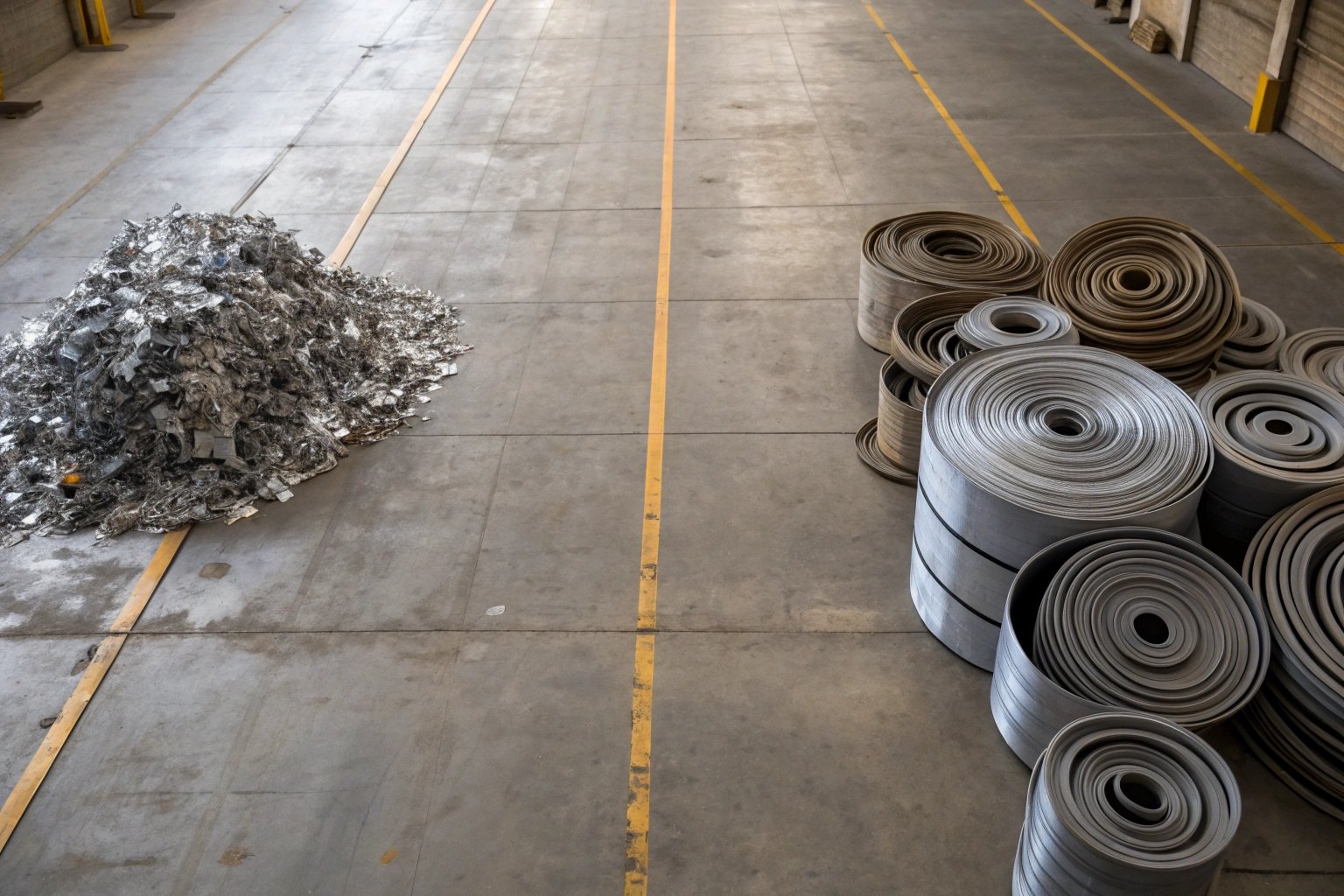
To understand this, imagine baking cookies. If you cut the dough in straight rows and columns, you have big star-shaped gaps between the circles. That is straight cutting. If you shift every other row so the circles fit into the gaps of the previous row, that is scroll cutting.
The Mechanics of Scroll Shearing
Scroll shearing cuts the master sheet into wavy strips (primary scroll) or zig-zag cutting patterns 5 (secondary scroll).
- Primary Scroll: The coil is cut into sheets with a wavy edge.
- Secondary Scroll: Those sheets are fed into the press, and the punch follows the wave.
In my factory in Fujian, we have dedicated lines for this. For a standard 307 (83mm) end, switching from straight cut to scroll cut can save roughly 7% of your metal bill. When you are buying 500 tons of tinplate from me, saving 7% is enough to pay for your shipping and duties.
Is the Scrap Rate Higher?
Technically, the percentage of scrap is much lower with scroll cutting. However, the risk is higher if the machine is not set up well.
- Straight Cut: High scrap (waste), low risk. It’s hard to mess up.
- Scroll Cut: Low scrap (waste), higher technical requirement. If the registration (alignment) is off by 1mm, you ruin the whole strip because the circles will overlap.
This is why we invest heavily in our cutting equipment. We use Japanese technology to ensure that when we supply you with scrolled sheets, the tolerance is perfect.
Why Straight Cutting is Still Common
Straight cutting (or gang slitting) 6 is used primarily for rectangular body blanks. Since the final product is a rectangle (which is then rolled into a cylinder), straight cuts are highly efficient. The only waste is the tiny trim on the edges to ensure the sheet is perfectly square. However, if you use straight cutting for round ends, you are wasting a massive amount of material. The "web" between the circles is thick and heavy.
Comparison of Cutting Methods
This table compares the two methods so you can decide which fits your production line.
| Feature | Straight Cutting (Slitting) | Scroll Shearing |
|---|---|---|
| Primary Use | Can Bodies (Rectangles), Industrial Cans | Can Ends (Lids), Drawn Cans (2-piece) |
| Material Efficiency | Low for circles (High waste) | High for circles (Saves 3-8%) |
| Tooling Cost | Low (Simple knives) | High (Specialized scroll dies) |
| Setup Time | Fast | Slow (Needs precise alignment) |
If you are producing millions of ends, you must use scroll cutting. If you are just making a few thousand cans, straight cutting might be cheaper just because you don’t need expensive dies.
Do you buy back the tinplate scrap or should I sell it locally?
When you look at the pile of shiny metal skeletons accumulating behind your press, you see money. It is natural to ask if you can ship that back to the supplier for a credit. I get this question often from new customers who are used to local supply chains.
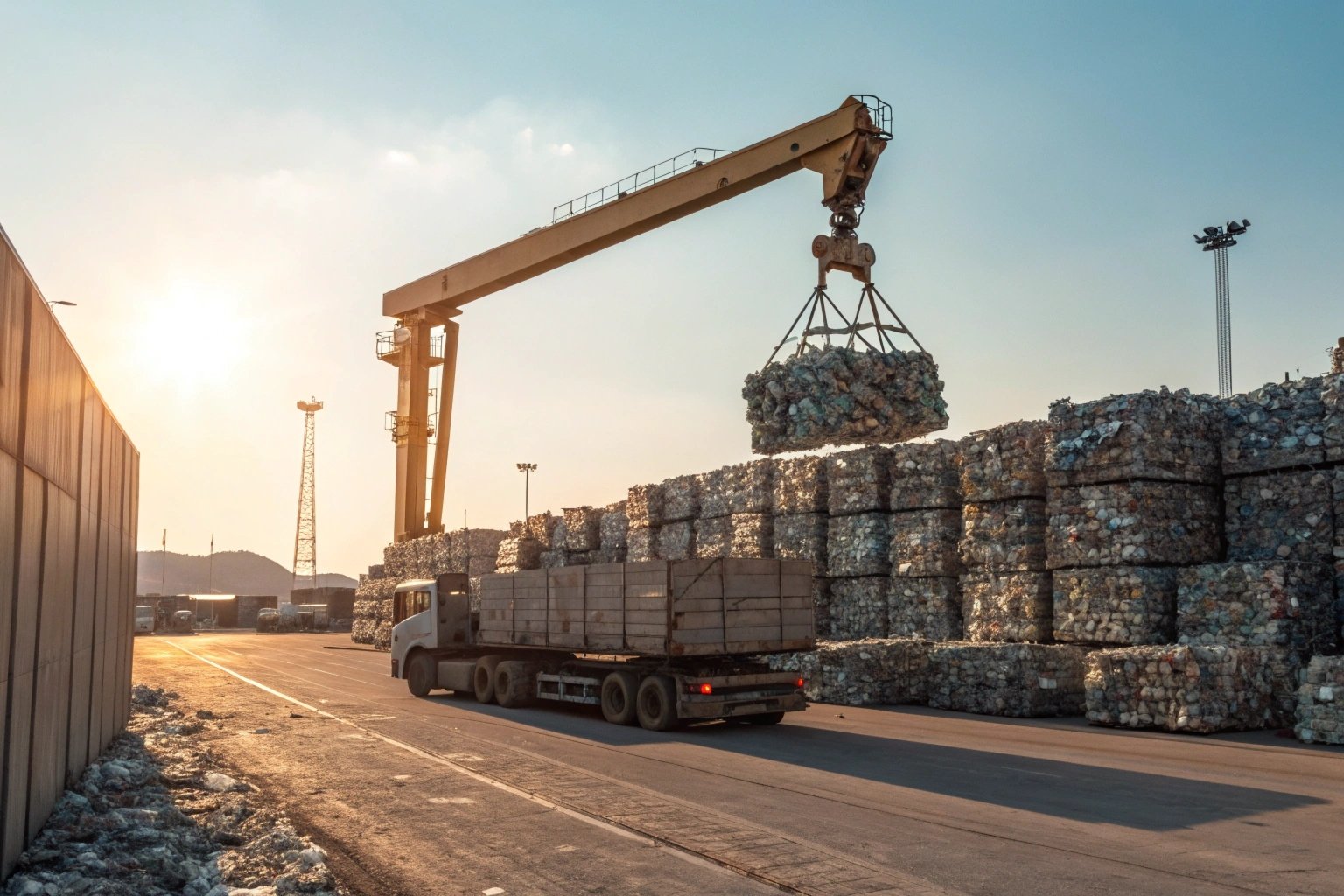
We do not buy back tinplate scrap because the logistics costs of shipping waste back to China far exceed the value of the scrap material. You should sell the scrap to local metal recyclers, as tinplate has a higher resale value than regular steel due to its tin content.
I want to be very transparent about the economics here. We operate on a global scale, and logistics is the biggest killer of margin.
The Logistics Reality
Let’s say you are in Mexico. To ship a container of scrap back to my factory in Fujian would cost thousands of dollars in ocean freight.
- The Math: Scrap steel might be worth $200-$300 per ton. Shipping might cost $100-$150 per ton. By the time it arrives, the value is gone.
- Regulatory Hurdles: China has very strict laws about importing "waste." Importing scrap metal requires special licenses and is heavily regulated to prevent pollution. It is almost impossible for us to legally import your production scrap back into China.
How to Maximize Value Locally
You should treat your scrap as a revenue stream, not just trash. Tinplate is not just steel; it is steel coated with Tin (Sn). Tin is a semi-precious metal, often trading at high prices (sometimes $25,000+ per ton on the London Metal Exchange 7).
There are specialized recycling plants that perform Detinning.
- Chemical Process: They dip the scrap in a hot caustic solution.
- Electrolysis: They recover the pure tin.
- Steel Scrap: The remaining steel (black plate) is baled and sold to steel mills.
If you sell your scrap to a general "junk yard," they will pay you the price of dirty steel. If you find a specialized tinplate recycler, they might pay you a premium because they want the tin.
Sorting for Profit
As a brand owner, you can also use this for your sustainability report. Steel is the most recycled material in the world. It is infinitely recyclable. By selling locally, you reduce the carbon footprint (no return shipping) and support the circular economy 8 in your own country.
Chase’s Tip: Segregate your scrap. Keep "clean" skeletons separate from "printed/lacquered" misprints. Some recyclers pay more for bare, bright silver scrap than for lacquered scrap because it is easier to process. The lacquer requires an extra step to burn off or strip before the tin can be recovered, which lowers the price they will offer you.
How much over-shipment should I allow to cover potential scrap?
You are placing an order for the tomato harvest season. You need exactly 500,000 cans. If you order material for exactly 500,000 cans, I can guarantee you will run short. But you also don’t want a warehouse full of leftover sheets that you can’t use next year.
You should generally allow for an over-shipment or "overage" of 5% to 10% for printed sheets to cover setup waste and color registration. For plain unprinted sheets, a 3% buffer is usually sufficient. The smaller the order quantity, the higher the percentage buffer you need.
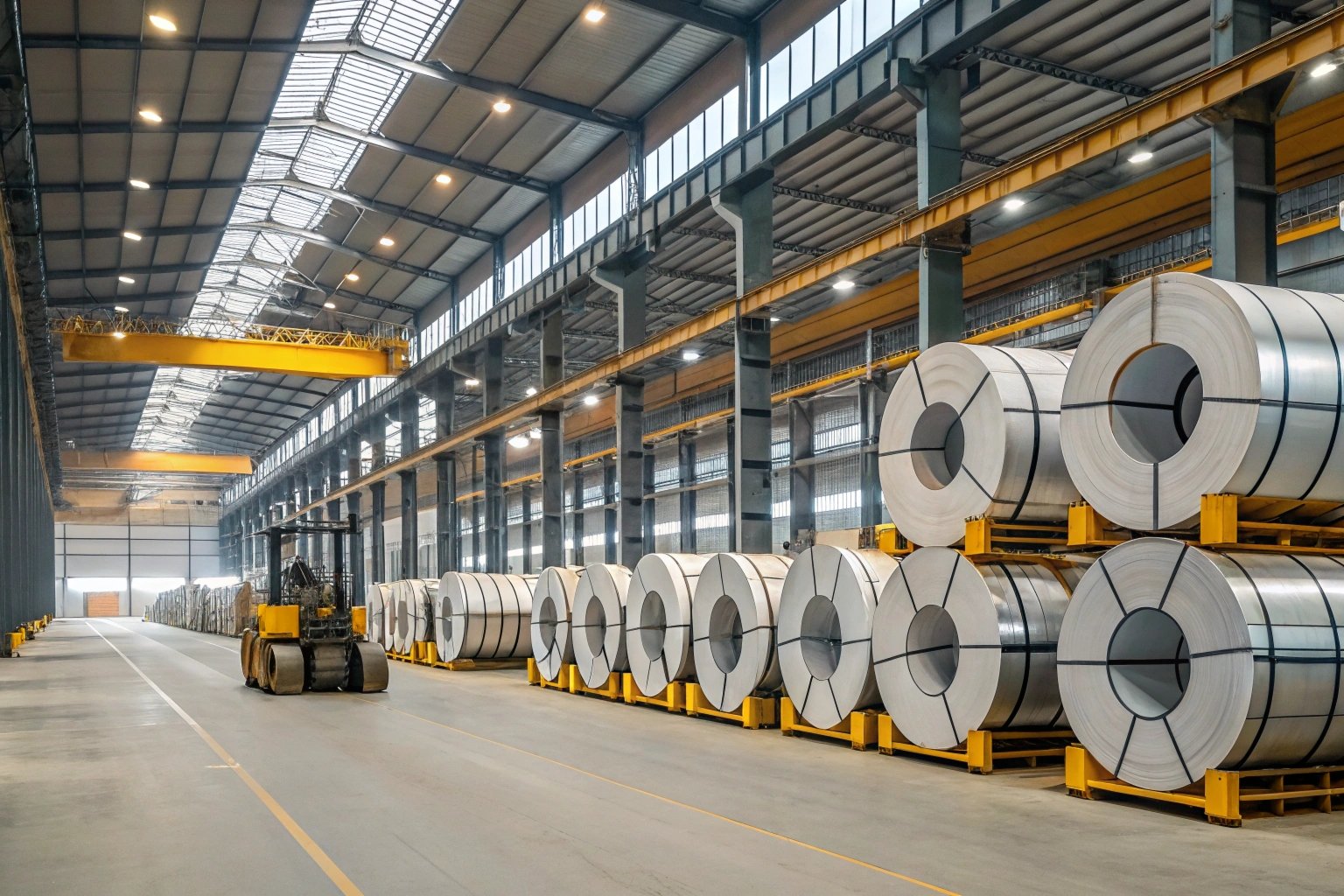
This is a classic "pain point" for my customers. If you order too little, your production line stops (disaster). If you order too much, you tie up cash in inventory (bad).
The "Make-Ready" Waste Factor
The biggest factor here is whether you are buying Plain or Printed tinplate.
If you buy Printed Sheets (which we produce in our Fujian plant using Fuji double-color lines):
Every time we start a printing job, we have to run "setup sheets" to align the colors. We might waste 50 to 100 sheets just getting the registration (the alignment between the different colors) perfect.
- If your order is small (e.g., 5,000 sheets), wasting 100 sheets is 2%.
- If your order is huge (e.g., 100,000 sheets), wasting 100 sheets is 0.1%.
Therefore, for small custom-print orders, I always recommend ordering 10% extra. For massive runs, 3-5% is safe.
Coating and Lacquering Loss
Even if you don’t print, you likely need a gold or clear lacquer on the inside for food safety. The coating machine also has start-up and shut-down waste. The first few sheets might have uneven coating thickness and must be discarded. Additionally, you will have your own internal scrap. Your welders might jam, or your seamers might be out of spec. You need material to cover these internal errors.
Huajiang’s Inventory Advantage
Here is where working with a supplier like us helps. Because we keep 100,000 tons of coil in stock, we have the flexibility to help you manage this.
- The "Rigid" Supplier: If you order 50 tons, they make 50 tons. If you have a lot of scrap and need 2 more tons, they say, "Sorry, minimum order is 20 tons." You are stuck.
- The Huajiang Way: We act as your buffer. If you are nervous about scrap, we can produce a little extra and hold it for you. Or, because we have standard sizes in stock, we can rush-ship a small replenishment order if you run into an emergency.
Recommended Overage Table
Use this guide when placing your next PO (Purchase Order) to ensure you have enough safety stock 9.
| Order Type | Production Process | Recommended Overage | Why? |
|---|---|---|---|
| Small Run | Multi-color Printing | 10% – 12% | High setup waste relative to total volume. |
| Large Run | Multi-color Printing | 3% – 5% | Setup waste is diluted over many sheets. |
| Any Size | Plain / Lacquered Only | 3% | Coating lines are stable; less waste than printing. |
| Trial Order | New Product Testing | 15% | You will have higher scrap during your own testing. |
Do not look at overage as a "cost." Look at it as an insurance policy. The cost of 5% extra metal is nothing compared to the cost of your canning line sitting idle for three weeks while you wait for more steel.
Conclusion
Estimating scrap loss isn’t just about guessing; it is about understanding the geometry of your layout and the reality of your machines. By accounting for the 8-15% geometric waste and adding the necessary buffers for process limitations, you protect your profit margins. Remember, it is always cheaper to recycle 10 a little extra scrap locally than to shut down your factory because you ran out of material.
Footnotes
1. Specifications and applications of electrolytic tin plate in packaging. ↩︎
2. How metal grain direction affects forming and structural integrity. ↩︎
3. Definition of process scrap in manufacturing operations. ↩︎
4. Overview of Easy Open Ends technology for food canning. ↩︎
5. Equipment and advantages of scroll shearing for metal recovery. ↩︎
6. Explanation of gang slitting machinery for rectangular blanking. ↩︎
7. Global marketplace for tracking non-ferrous metal prices. ↩︎
8. Economic model aimed at minimizing waste and maximizing resources. ↩︎
9. Calculation methods for inventory buffers to prevent shortages. ↩︎
10. Industry standards and benefits of scrap metal recycling. ↩︎